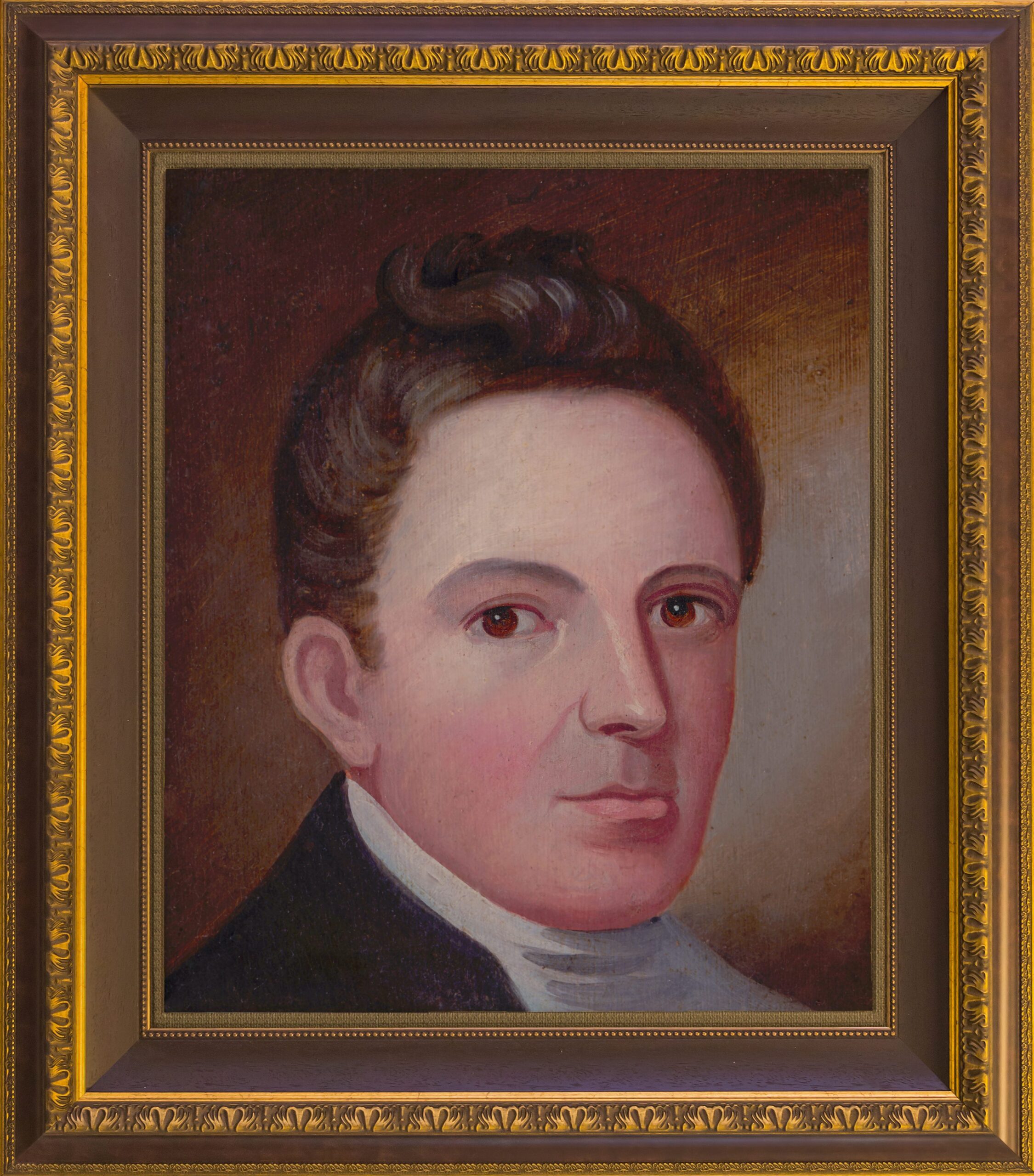
Title: Portraits of signers of the Declaration of Independence
Call Number: MSS 12130
Citation: Robert Edge Pine. Copies of Pine's Portraits of Signers of the Declaration of Independence,1820, Accession #12130, Albert and Shirley Small Special Collections Library, University of Virginia, Charlottesville, Va.
This photo has been identified as being free of known restrictions under copyright law, including all related and neighboring rights.
 Click photos to enlarge
-
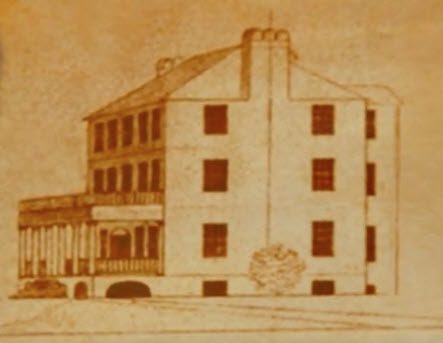 Middleton's original house before the addition of wings in 1755 by Arthur's father
 -
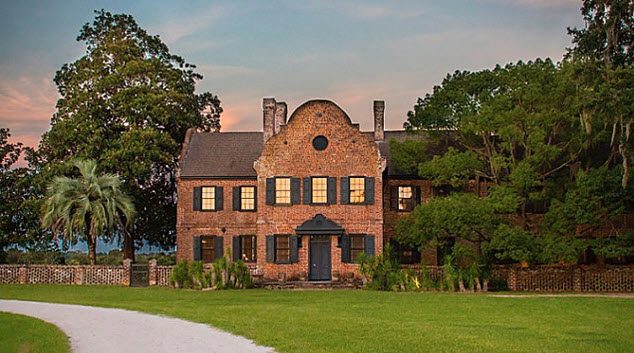 Middleton Place
 -
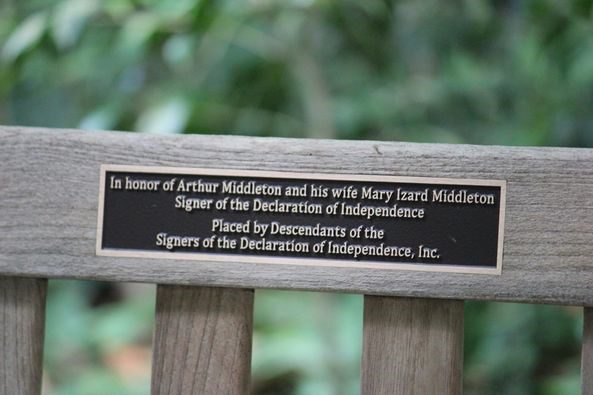
 Plaque honoring Arthur and Mary Middleton installed on a bench at Middleton Place at the Spring 2024 meeting in Charleston, South Carolina
 -
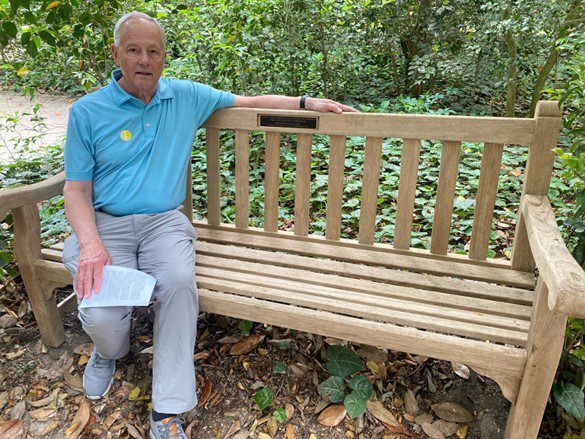
 Mid Ramsey sits on the bench dedicated to his ancestors Arthur and Mary Middleton at Middleton Place.
 -
 Arthur Middleton from a portrait of the Middleton family by Benjamin West
Spouse Information:

Mary Izard
(1747 - 1814)
Read Spouse Bio
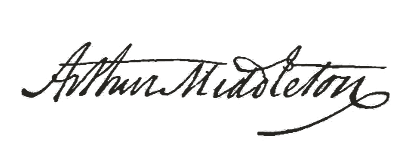
Arthur Middleton
Arthur Middleton, American patriot, and signer of the Declaration of Independence, was born on June 26, 1742 in a manor house known as Middleton Place on the banks of the Ashley River in South Carolina. He was the eldest son of the Honorable Henry Middleton and his mother, Mary Williams, only daughter of John Williams, a wealthy landowner, Justice of the Peace, and member of the Assembly.
Arthur’s great-grandfather, Edward Middleton (1641-1685), had long been acquainted with the America’s having emigrated with his brother, Arthur, to Barbados, perhaps on the ship, Dorset. Edward’s brother is documented to have been in Barbados by 1675. Several decades later, in 1768, Edward Middleton emigrated to the low country of South Carolina, where he became Lord Proprietor’s deputy and assistant justice of the Grand Council, 1768-1684. He received large grants of land on Goose Creek on which he proceeded to establish a plantation which he named the Oaks. Edward’s son Arthur (1681-1737) was born at The Oaks, and inherited estates in England, Barbados, and South Carolina, who became quite active in public life. He became President of the Convention that overthrew the Lords Proprietors in 1719 and became acting Governor of the Colony from 1725-1730. His wife, Sarah Amory, was the daughter of Jonathan Amory, who was appointed by the Crown as advocate general in South Carolina Admiralty Courts, and became Speaker of the House of Commons.
Arthur and Sarah Amory Middleton’s son, Henry Middleton (1717-1784), was ranked as one of the wealthiest, most influential, and politically active men in the province. Henry began construction of Middleton Place, South Carolina in 1741 (Arthur born in 1742), a home that would become both an intellectual and emotional focus for successive generations of Middletons. He owned approximately 20 plantations that embraced over 50,000 acres, and about 800 slaves. Henry was Speaker of the Commons, Commissioner for Indian Affairs, and a member of the Governor’s Council until 1770 when he resigned the seat to become a leader of opposition to British policy. Henry was chosen to represent South Carolina in the first Continental Congress, and on October 22, 1774 was elected President of that august body. He served for a year, but when asked to serve another term, declined due to reasons of health. He wanted to return to his home in South Carolina to spend his remaining years at the Oaks with the knowledge that his son, Arthur, would succeed him in the Second Continental Congress.
Arthur Middleton’s earliest education was provided by tutors and private schools in Charleston. As was the custom of the time, Arthur was sent to England at the age of 12 for further education. He attended Harrow, Westminster School, Trinity Hall at Cambridge. It was here that he acquired a thorough education in the Greek and Roman classic literature that he continued to enjoy throughout his life. He was a serious scholar, avoiding some of the exploits of his less dedicated American companions. In 1757, Arthur was admitted to Middle Temple to study law. Records at Cambridge do not indicate that he graduated from law school.
In 1763, at the age of 21, Arthur returned to Middleton Place, South Carolina on the ship Nancy. Soon afterwards, he met and then married Mary Izard on August 19, 1764. Mary’s father, Walter Izard, was a justice of the peace at Cedar Grove, a plantation across the river from Middleton Place, in Berkeley County, and was captain of a Berkeley regiment in 1712 and served in the Yemassee War. Arthur settled in with his bride at Middleton Place. Arthur’s wife was a cousin of South Carolina Congressman Ralph Izard. Ralph’s son, Henry Izard, married Arthur and Mary’s daughter; Emma Philadelphia, and his son Ralph, married the Middleton’s niece; Elizabeth, daughter of Arthur’s brother, Thomas. Thomas Middleton was appointed a Justice of the Peace in Berkeley County in 1765, and was a member of the provincial House of Commons from 1765 to 1768.
Imbued with his love of travel firmly implanted from his formative years spent abroad, Arthur and Mary left South Carolina in 1768 on a three-year tour of Europe. It was during this time, their sone who they named Henry was born in London (1770-1846). He was totally educated by tutors until after his father died when he was sixteen. Upon his father’s death, his uncles, Edward Rutledge and Charles Cotesworth Pickney arranged for him to visit Congress and then travel to Europe. The family sat for a portrait during this time abroad with the artist Benjamin West. Speaking Later of Mary in his diary, Dr. James Clitherall, a family friend, stated that he experienced much happiness in the pleasure of Mrs. Middleton’s conversation, “a Lady who is one of the first of her sex for sense, politeness and every female accomplishment.” She has been described by others as a most gracious hostess but specifically by Francis Hopkinson, another signer, who in writing to Arthur Middleton, stated that he had passed many agreeable hours with “my valued friend your good Lady.”
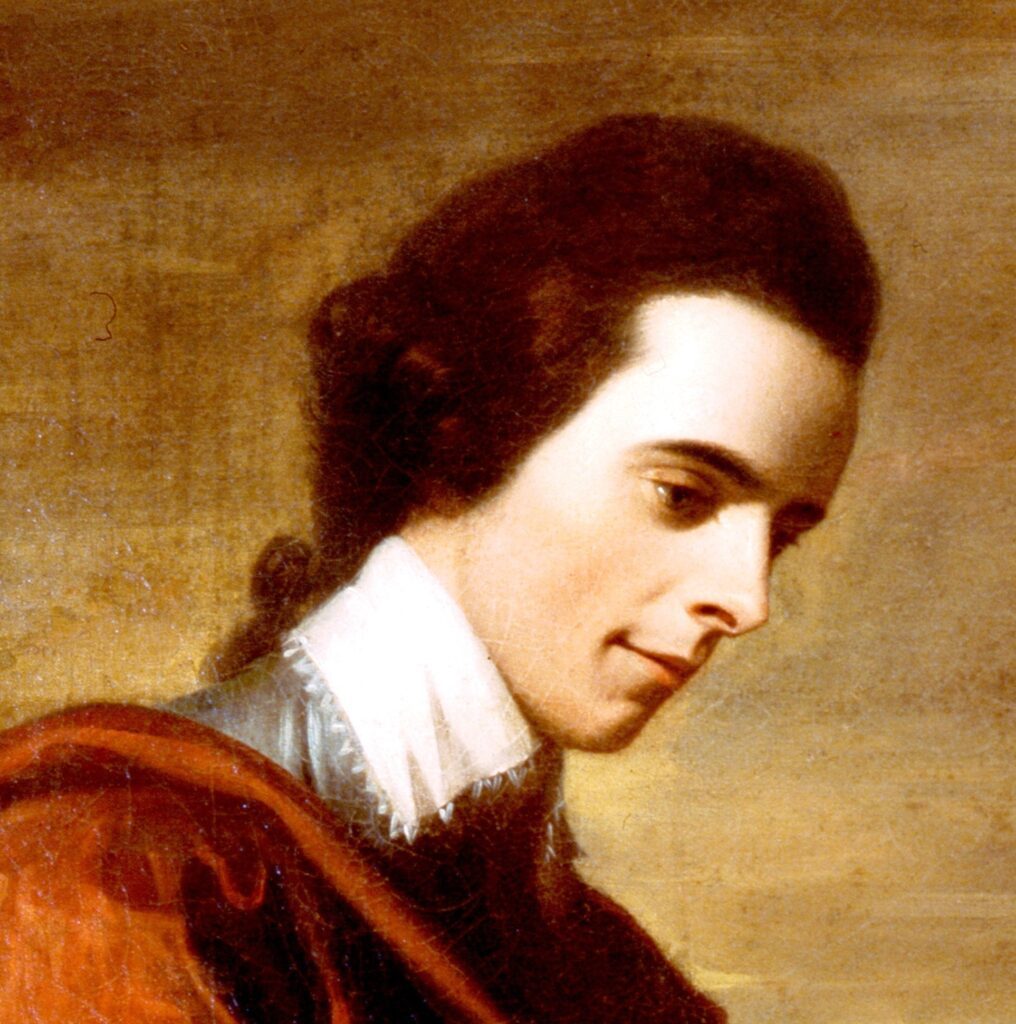
Fellow signer Benjamin Rush described Arthur Middleton “as a man of cynical temper but upright intentions towards his country.” He has variously been described by others as being middle-sized, well-formed with great muscular strength and fine features expressive of firmness and decision, a celebrated, capricious aristocrat but like his forbears, very public spirited. While still in his twenties, Arthur became keenly interested in politics and was considered a more radical thinker than his father in opposition to Parliament. He was again elected to the South Carolina provincial House of Commons from 1772 to 1775. He became a leader in the “American Party” in Carolina and was appointed by the Provincial Congress in 1775 to a secret committee of five men authorized to place the colony in a “posture of defense.” He recommended a variety of defensive measures for Charleston Harbor. Upon the Committee’s edict, the Royal Magazine of Arms and Ammunition was appropriated for the defense of the Colony.
Middleton became a forceful advocate for anti-Loyalist actions, including tar and feathering and confiscation of estates belonging to Loyalists who had fled the country. In June, 1775, Arthur was one of 13 chosen for the Council of Safety. This council took measures to organize a military force, the officers of which received commissions at their hands and under their signature. He engaged in drafting a state constitution and designed the great seal of South Carolina working with William Henry Drayton. When Henry Middleton became ill, Arthur took his father’s place in the Second Continental Congress where it was reported that he spoke forcefully and frequently. That most important period in our nation’s history culminated in the signing of the magnificent and courageous document called the Declaration of Independence. After taking part in that momentous event, Arthur returned home and, as an officer of the local militia, was actively engaged in the defense of the city of Charleston. British forces landed near Charleston in 1780 and ravaged the surrounding area and many of the plantations, including Middleton Place. While the buildings remained intact, the British and Loyalists stole anything of value they could carry, and destroyed everything they could not carry. The Middleton’s escaped capture at that point by fleeing to Charleston ahead of the British raid. But when the British occupation of Charleston began, three South Carolina signers, Arthur, his brother-in-law Edward Rutledge, and Thomas Heyward were captured, taken from their homes, and were incarcerated for almost a year in Saint Augustine, Florida. In July, 1781 he was freed in a prisoner exchange to Philadelphia, he was appointed by Governor John Rutledge (the brother of Edward Rutledge) to Congress. He was re-elected to that seat in 1782. In November of that year, he returned to South Carolina to visit his family from whom he had been separated and to view for the first time the plundering and devastation wrought by the British during their occupation of Middleton Place.
When peace was assured, Arthur decided to return home to Middleton Place for good in 1783, after declining another seat in the Congress, preferring instead the pleasure of retirement and enjoyment of his estate. He began restoring order to his plantation. Much of what is seen there today was influenced by the Middleton family’s travels abroad. He did serve in the State Legislature and became one of the original Trustees of Charleston College. Arthur Middleton died in 1787, the year of our Constitution, at the young age of 44, but by then his work was finished, and his legacy assured. He was buried in the family mausoleum in his beloved 18th century garden.
The Middleton family continued their tradition of patriotism and service to country throughout succeeding generations. Arthur’s son Henry followed in his father’s footsteps serving in both houses of the State Legislature and a term as Governor of South Carolina. He served as Minister to Russia during the entire decade of the 1820s, after serving in Congress. While in Russia, Henry was instrumental in negotiating the first treaty between the United States and Russia relative to navigation, fishing, and trading in the Pacific Ocean and establishments of the north and west coasts.
Henry’s son Williams (grandson of Arthur and Mary) was Secretary for the American Legation in Russia. Later, he became active in the politics of his day. He supported states’ rights and signed the Ordinance of Secession separating South Carolina from the Union prior to the American Civil War. During the ensuing war, Middleton Place was once again the scene of wanton destruction, burning, pillaging, and looting of valuables by Union troops.
Middleton Place has been devastated by wars, earthquakes, hurricanes, and the ravages of time, but fortunately visitors today may still visit this historic site, tour the gardens, rice paddies, and stable yard. The entire stately manor overlooking the butterfly lakes is no more, only one flanker remains of that house, but the legacy of Arthur Middleton and his family still stands as tall today as it did in years past—a sense of right, civic duty, and a solid belief in the principles of life, liberty, and the pursuit of happiness. Arthur Middleton was a remarkable member of a family that acted upon the patriotism that they so firmly believed in, preferring the welfare of their country to private interest or financial gains.

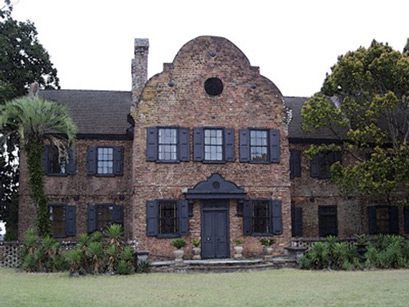
The house is now owned by the Middleton Place Foundation and is a National Historic Landmark. It has been remodeled and is no longer furnished with Middleton family possessions. Now a museum, it houses the exhibit “Conversations of Freedom: The American Revolution at Middleton Place” in honor of the 250th Anniversary. It explores the role of the Middleton family and their enslaved workers in the Revolution, as well as the Declaration and events in South Carolina and the colonies.
In honor of the signer, one of the U.S. Navy attack transports built during World War II was named the USS Arthur Middleton, and saw service in the Pacific Theater. These ships were designed to transport troops and their equipment to hostile shores to execute amphibious operations. They carried a substantial number of landing craft, and were heavily armed with anti-aircraft weaponry to protect their valuable cargo of troops from air attack.
In Washington, D.C., on the mall near the Washington Monument, is a park and lagoon dedicated to the Signers of the Declaration, and one of the 56 granite markers there carries the engraved name of Arthur Middleton. A bench in honor of Arthur and Mary Middleton was placed by DSDI in 2024 at Middleton Place. In the Rotunda at the U.S. Capitol hangs the famous Trumbull painting, “The Declaration of Independence.” The figure of Arthur Middleton is shown standing in a group of five delegates on the left side of the painting, on the extreme right of the group, with his head tilted forward.
Hope Middleton Wood – 4th Great-Granddaughter of Arthur Middleton, and member of DSDI. Updates provided by Dottie Stone, Ph.D., Middleton Place Foundation, 2026
Sources:
- The Story of the Declaration of Independence, Dumas Malone, Oxford University Press, 1975
- Famous Signers of the Declaration, Dorothy Horton McGee, Dodd, Mead & Co, 1966
- Lives of the Signers of the Declaration of Independence, The Reverend Charles A. Goodrich, William Read & Co., 1842
- The Signers of the Declaration of Independence, Della Gray Barthelmas
- Signers of the Declaration, National Park Service, Series Editor Robert G. Ferris
- Internet reference: Colonialhall.com
- South Carolina Historical Society Magazine, Diary of Dr. James Clitherall
- Middleton Place Foundation